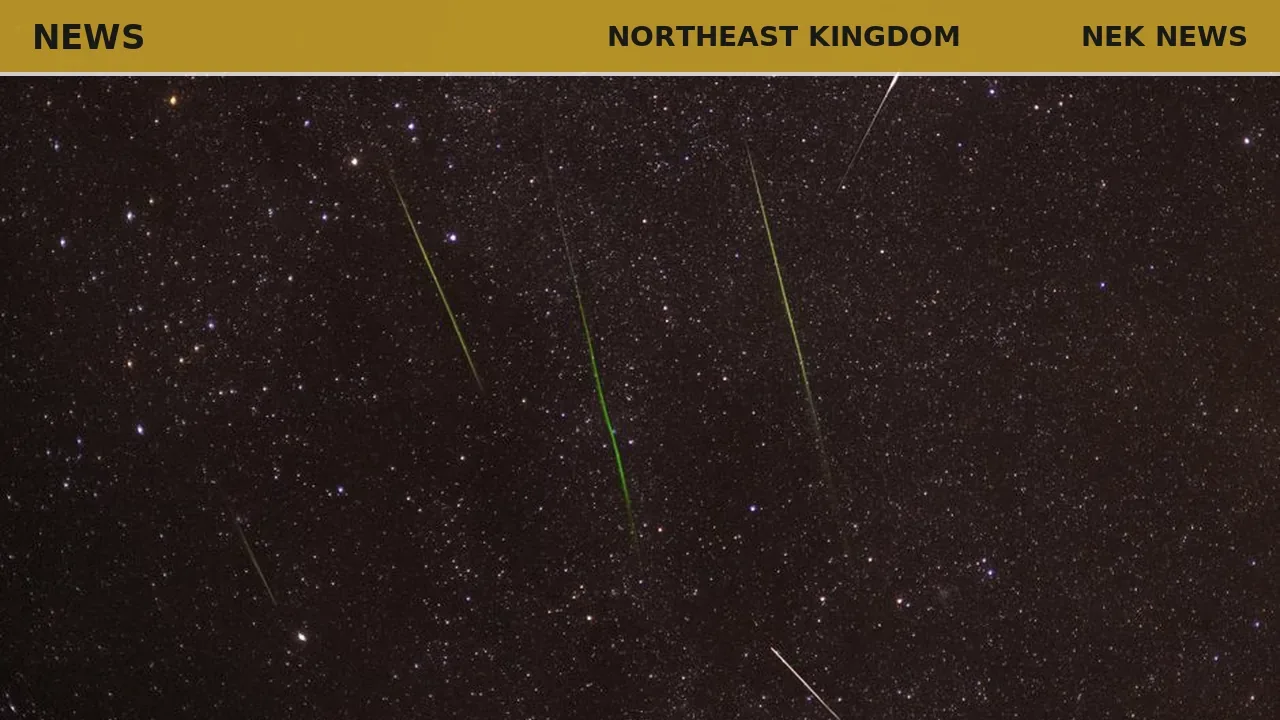
The Northeast Kingdom is one of the last places in the United States where the night sky still appears genuinely dark, according to a new report from DarkSky International. Artificial light at night now affects more than 80% of people worldwide and more than 99% of Americans, the report found. In the Northeast Kingdom, the Bortle Dark-Sky Scale, which rates skyglow from 0 (pristine) to 10 (parking lot), comes in at 2 or 3, said Bill Vinton of the Northeast Kingdom Astronomy Foundation. At that level, the Milky Way is visible as a distinct band, and on clear August nights the Perseid meteor shower can produce dozens of meteors per hour.
The region's remoteness has preserved its darkness, but local volunteers warn that it is not guaranteed. Two years ago a group launched DarkSky Vermont, a grassroots effort to help towns and residents protect what they have. “We looked at every town plan in the region and built a classification model. Towns were surprised, there was a lot of support for it,” said Jon McCann of DarkSky Vermont. The group encourages residents to push for dark-sky language in town plans. Lincoln, Vermont, adopted outdoor lighting bylaws in 2004 and updated them in 2016.
The switch to LED lighting, often framed as an environmental gain, may be undermining those efforts. The DarkSky report notes that LEDs are more energy-efficient, but their low cost has led to more lighting overall, and their blue-heavy spectrum is more disruptive to wildlife and human circadian rhythms than older warm lights. The promised energy savings have largely been consumed by simply using more light.
DarkSky Vermont recommends switching to fully shielded, downward-facing fixtures with warm color temperatures (2700K or below), and using timers or motion sensors instead of lights burning all night. The group also encourages residents to get outside during the Perseid meteor shower, which peaks Aug. 12-13, and to attend star parties hosted by the Northeast Kingdom Astronomy Foundation.
NEK will be looking into how many towns in the region have adopted or are considering dark-sky protections in their local plans.
Originally reported by North Star Monthly.
Photo: Eclipse Chasers via Pexels. Photo is illustrative and not from the scene.

Log in as a subscriber to comment, or become a member.